

Haram Sound System: The Complete Breakdown of Masjid al-Haram's Audio
"Can you make our masjid sound like the Haram?"
It is the most common request we receive at Bamaga Studios. Masjid committees across the United States have experienced the crystal-clear, perfectly balanced sound of Masjid al-Haram in Makkah — either in person during Umrah or Hajj, or through live broadcasts — and they want that same experience for their own community.
The question is not unreasonable. The Haram sound system is the gold standard for masjid audio in the world. I have visited Masjid al-Haram multiple times. Most people notice the architecture and the Kaaba. I notice the speakers, the microphone positions, and the signal chain. What follows is the most detailed breakdown of the Haram sound system available anywhere — and what it actually means for your masjid.
THE SCALE: BY THE NUMBERS
The Grand Mosque sound system operates at a scale that has no parallel anywhere on earth.
Over 8,000 loudspeakers are distributed throughout the mosque's interior, its multiple floors, outdoor courtyards, corridors, basements, and surrounding streets. In a 2026 upgrade, over 260 advanced speakers were deployed along the roads and pathways surrounding the Haram, connected via an 8-kilometer fiber-optic cable network to ensure zero-latency synchronization with the indoor arrays.
The primary audio nerve center is a 500-square-meter control hub — the southern loudspeaker chamber located inside the mataf building near the Kaaba. This control room houses heavy-duty digital matrix processors and a dedicated 117-ton HVAC system installed purely to keep the audio equipment cool. In the extreme heat of Makkah, where summer temperatures regularly exceed 45 degrees Celsius, thermal management is not an afterthought — it is a core engineering requirement.
The system is monitored 24 hours a day, 7 days a week by a full-time team of over 50 specialized audio engineers who perform daily sound balance and EQ adjustments before every prayer. There are not one but three independent layers of redundancy: a Primary System, a Backup System, and a dedicated Emergency System. The mandate is 0% failure tolerance. When the Imam begins the prayer for two million worshippers, there is no acceptable technical failure.
THE MICROPHONE SYSTEM
The acoustic journey begins at the Imam's position. The distance from the microphones to the control studios is vast — and across long cable runs, analog audio signals degrade. The solution the Presidency of the Two Holy Mosques relies on is fully digital signal capture right at the source.
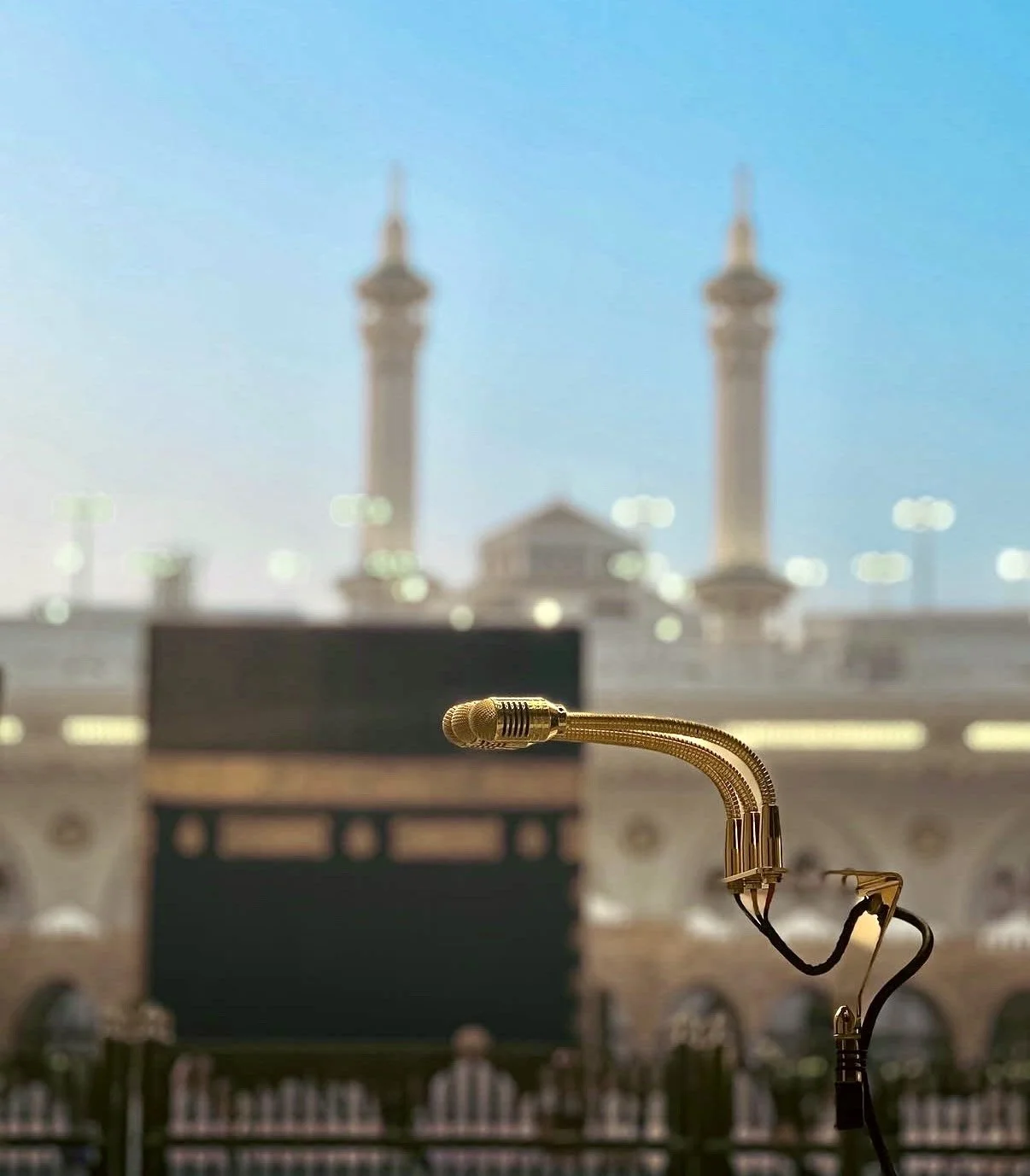
The Imams at Masjid al-Haram use Sennheiser MKH 8040 cardioid condenser microphones. These are chosen specifically for their exceptional clarity, extremely low self-noise, and highly directional pickup pattern — which rejects the ambient noise of millions of worshippers while capturing the Imam's voice with surgical precision.
Attached directly to each microphone are MZD 8000 digital modules, which convert the analog audio signal into a pristine digital signal right at the microphone capsule — before it travels a single meter of cable. The network is controlled via Neumann DMI-8 digital microphone interfaces, which allow engineers to remotely adjust gain and monitor signal levels from the underground control room without anyone physically touching the microphones.
Three microphones are positioned at the Imam's position simultaneously. The right microphone is the primary. The center is the first backup. The left is the second backup. If the primary fails, the first backup activates automatically. If that fails, the second backup takes over. The result is a mathematically near-zero probability of microphone failure during salah.
THE SPEAKER TECHNOLOGY: WHY BEAM STEERING IS THE ANSWER
The architectural reality of Masjid al-Haram is an audio engineer's greatest challenge: millions of square meters of highly sound-reflective marble. Marble absorbs almost no sound energy. In the main prayer hall, initial reverberation times can exceed 4 seconds — meaning a single spoken syllable echoes for four seconds after it is said, completely masking the next word.
Traditional solutions — large, powerful PA speakers at the front of the room — make this dramatically worse. They push massive amounts of sound energy into a reverberant space, creating a wall of echo that destroys intelligibility.
The solution at Masjid al-Haram is beam steering combined with distributed audio.
For the indoor spaces, the system utilizes Duran Audio AXYS Intellivox steerable column arrays. These units use Digital Directivity Synthesis — often called beam shaping — to focus acoustic energy precisely onto the listening plane where the worshippers are seated, while keeping sound off the marble ceilings and upper walls. The result is that worshippers hear clear, direct sound from a nearby speaker at comfortable volume, while the reverberation of the space is dramatically reduced because the reflective surfaces are receiving far less acoustic energy.
For the massive outdoor courtyards, Eastern Acoustic Works (EAW) in collaboration with the acoustic consulting firm Acentech designed custom 14-meter-tall line arrays. These towering outdoor speaker systems use complex Digital Signal Processing to steer sound frequencies across the vast open plazas — projecting the Adhan up to 6,000 meters away into the Makkah valley without overwhelming the worshippers standing directly beneath them.
For the minarets and extreme outdoor environments, Community Professional Loudspeakers handle the high sound pressure level requirements. These horn speakers are engineered for harsh environmental conditions — wind, heat, humidity — and designed to throw sound across large distances with maximum clarity.
The overall safety and emergency infrastructure is tied into a Bosch Praesidio system, which serves as the fail-safe emergency voice alarm and evacuation network. In an environment housing up to two million people simultaneously, life-safety audio is a separate, dedicated system.
Renkus-Heinz Iconyx beam-steering column arrays — the same brand we use in our US masjid installations — have been extensively modeled and simulated in ongoing acoustic optimization research for the Grand Mosque. The Iconyx IC16 and IC32 models are being studied specifically for their ability to digitally lower the acoustic center of the speaker, keeping sound energy precisely on the worshippers and completely off the upper walls and domed ceilings. During my most recent visits, Renkus-Heinz installations are also visible in areas of the complex — reinforcing why this technology is increasingly the standard for world-class Islamic spaces.
THE BROADCAST CHAIN
The sound at Masjid al-Haram does not just serve those present. It serves the entire Islamic world.
The audio feeds from the Imam's microphones are routed through dual independent control rooms into heavy-duty digital matrix mixers. From there, the audio network is directly integrated with the Saudi Broadcasting Corporation studios located on-site. The raw audio is embedded with live camera feeds and transmitted via satellite for live television and radio broadcasts globally — reaching over a billion Muslims watching from every country on earth.
The same signal that travels through a Sennheiser MKH 8040, gets digitized by an MZD 8000 module, travels through 8 kilometers of fiber-optic cable, is processed by digital matrix systems, and exits through 8,000 time-aligned speakers — all in less than a millisecond — is the same signal broadcast to televisions in Houston, London, Jakarta, and Cairo simultaneously.
THE LESSON FOR MASJID ACOUSTICS WORLDWIDE
The engineering philosophy behind Masjid al-Haram has quietly become the blueprint for high-performance mosque audio around the world. Several principles stand out that any masjid — regardless of size or budget — can learn from.
Distributed audio beats brute force. The Haram does not use a handful of massive speakers pointed at the congregation. It uses thousands of smaller, precisely placed, digitally synchronized speakers so that every worshipper is close to a sound source. This keeps volume levels comfortable while dramatically reducing the echo that plagues masajid with reflective surfaces.
Beam steering solves what treatment cannot. In a space where you cannot cover the marble walls with acoustic panels, you solve reverberation at the speaker level — by directing sound precisely where people are sitting and away from the surfaces that cause echo. This is the core technology behind the Duran Audio and EAW systems at the Haram, and it is now available at scales appropriate for masajid of any size.
Redundancy reflects the weight of the responsibility. The triple-redundant microphone system at the Haram exists because the people who built it understood what is at stake. Two million Muslims cannot be left in silence because a single component failed. That same mindset — treating the audio system as sacred infrastructure rather than a commodity purchase — is what separates a system that serves the prayer from one that merely amplifies it.
Digital signal processing is what makes it all work together. DSP is the invisible backbone of the Haram system — synchronizing thousands of speakers, steering acoustic beams, managing zones, and maintaining intelligibility across an impossibly complex space. Without it, 8,000 speakers would produce 8,000 competing echoes. With it, they produce one clear, unified voice.
These are not principles reserved for billion-dollar projects. They scale down to any prayer hall — and they explain why two masajid with identical budgets can sound completely different depending on how the system was designed.
Book a free consultation at bamagastudios.com or call (832) 463-1413. We will assess your space and tell you exactly what it would take to bring Haram-level clarity to your masjid.
