

Masjid Al-Nabawi Sound System: Complete History from Altec Lansing to Renkus-Heinz ICONYX Gen5
This article began with a question from a friend.
Saudi-based researcher and Madinah documentarian @madeenahalmunawwara — who runs the website madinahfiles.wordpress.com and dedicates his work to documenting the architecture, history, and details of Madinah al-Munawwarah — sent photographs taken inside and around Masjid al-Nabawi asking a simple question: what are these speakers, and why do they look so different from each other?
As an AV professional who has been consulted on the Nabawi sound system across multiple visits and studied its evolution over time, I knew the answer was not simple. What those photographs captured was not one sound system. They captured five decades of audio engineering layered on top of each other — old technology sitting alongside new, a system in active transition from one generation of equipment to the next.
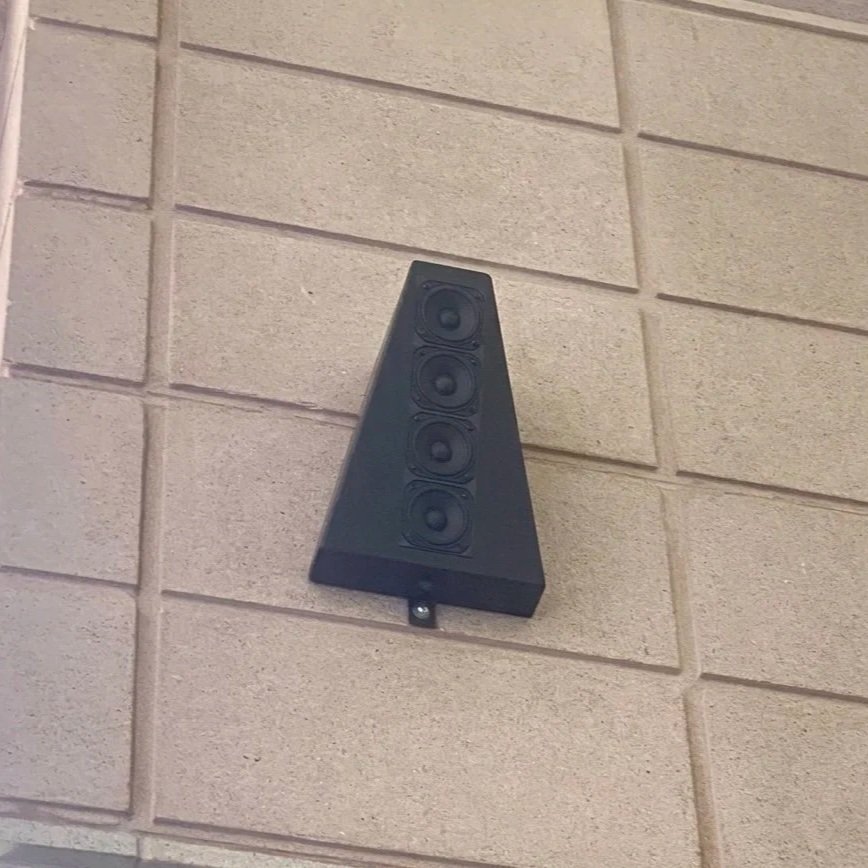
The first photograph showed a distinctive black wedge-shaped speaker — triangular in form, with four small full-range drivers arranged vertically on the face, mounted on an exterior stone wall. A second photograph showed the same speaker in cream/white on an ornate gold-decorated marble pillar inside the mosque — one with the grille on, another with the grille removed showing the four raw drivers underneath. His question: what is that trapezoid speaker?
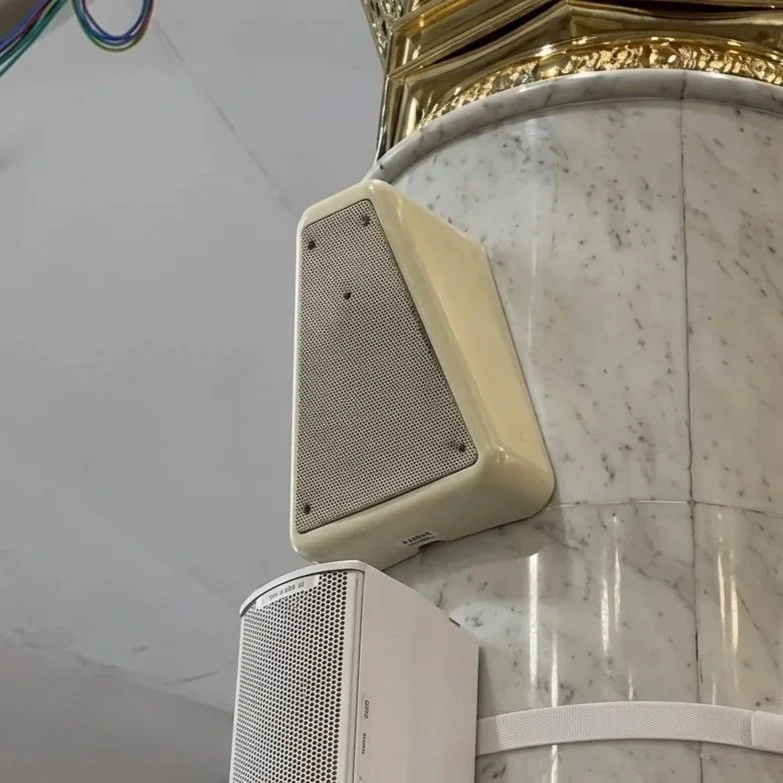
The answer is the Bose Panaray 402 Series. And that answer opens a much longer story.
For further reading on Madinah architecture and documentation, visit madinahfiles.wordpress.com or follow @madeenahalmunawwara on Instagram.
THE FIRST QUESTION: WHAT IS THAT TRAPEZOID SPEAKER?
The photograph that started this conversation showed a distinctive black wedge-shaped speaker mounted on an exterior stone wall — a triangular enclosure with four small full-range drivers arranged vertically on the face. The same speaker appears in cream/white color on the ornate gold-decorated marble pillar bases inside the mosque — one photo showed it with the grille on, another with the grille removed, exposing the four raw drivers underneath.
These are the same speaker. The black version is the outdoor variant. The cream version is the indoor variant. Both are the Bose Panaray 402 Series — one of the most widely deployed distributed array speakers of the late 1990s and early 2000s.
The Panaray 402 was a genuinely innovative product for its era. Bose designed it around their Acoustic Waveguide technology, using multiple small drivers in a wedge enclosure to create a wide, even horizontal dispersion pattern while keeping vertical dispersion controlled. The triangular form factor was not aesthetic — it was acoustic. The angled baffle and driver array were engineered to project sound toward a congregation at close range with minimal energy going toward ceilings and floors.
For a distributed system covering thousands of pillar positions across a mosque the size of al-Nabawi, the Panaray 402 was a reasonable choice at the time of installation. It is compact, self-contained, easy to mount, and delivers intelligible speech at moderate volumes from short distances.
As of the most recent documented visits, a significant number of Bose Panaray 402 units remain installed and functioning throughout Masjid al-Nabawi — both in the indoor prayer halls and in the haswa outdoor areas. They are not decommissioned relics. They are still active parts of the current sound system. However, they are being progressively replaced as part of an ongoing transition to a newer generation of technology.
THE HISTORY BEFORE THE PANARAY: ALTEC LANSING HORNS
Before the Bose Panaray era, the outdoor areas of Masjid al-Nabawi used Altec Lansing horn speakers — the classic large-format horn enclosures that dominated outdoor PA installations for decades. These units were mounted around the perimeter of the outdoor piazza and on the exterior walls, designed to project sound across open space.
The Altec Lansing horns had a fundamental limitation: a frequency response of approximately 500Hz to 10kHz. Everything below 500Hz — the full chest resonance and warmth of the human voice — was absent from the outdoor audio. The system delivered volume and intelligibility for the spoken word, but it did not deliver the full acoustic character of the Imam's recitation.
THE CANOPY CRISIS: HOW AN ARCHITECTURAL DECISION FORCED A COMPLETE REDESIGN
The turning point came when 250 retractable umbrella canopy structures were installed across the outdoor piazza. Each canopy measured 26 meters by 26 meters — designed by German engineering firm SL-Rasch GmbH — and they transformed the outdoor experience for worshippers by shading the marble piazza from the intense Madinah sun.
They simultaneously destroyed the outdoor sound system.
The Altec Lansing horn speakers had been aimed to project sound across open space. When the canopies were deployed, they sat directly in front of the speaker arrays. Sound struck the underside of the fabric structures and scattered unpredictably. The degradation was immediate and significant — mosque authorities commissioned a full acoustic study.
The engineer assigned to solve the problem was Ahmad Tekin Topuzdag, an Istanbul-based AV systems integrator who served as sound system manager for both Holy Mosques for over a decade. His analysis established that the replacement outdoor system would need to deliver approximately 160,000 watts of audio power to achieve uniform 84dBA coverage across the 257,000 square meter piazza.
THE JBL CBT UPGRADE: SOLVING THE CANOPY PROBLEM
For the outdoor piazza solution in 2013, Topuzdag selected 140 JBL CBT 70J-1 column line array speakers paired with 85 JBL CBT 70JE-1 low-frequency extension columns — 225 JBL CBT units total.
The CBT series uses Constant Beamwidth Technology — a design approach that maintains consistent vertical coverage across the full frequency range. Conventional speakers disperse high frequencies in a narrow beam while low frequencies spread wide, creating uneven coverage as you move through a space. The CBT column maintains the same controlled dispersion pattern from bass through treble.
The 85 CBT 70JE-1 low-frequency extension columns finally addressed the 500Hz limitation that had plagued outdoor Nabawi audio since the Altec Lansing era. With extensions, the combined system delivered full frequency response from 60Hz to 20kHz — including the complete low-end warmth of the Imam's voice outdoors for the first time.
The 225 JBL CBT speakers are powered by 32 Crown CDi 6000 amplifiers. Crown was specified for thermal stability under continuous operation — five prayers per day, every day, in outdoor temperatures regularly exceeding 45 degrees Celsius. Signal processing is handled by a BSS Audio BLU-160 digital matrix processor, which manages delay alignment across all 225 speakers and gain compensation for cable runs extending to 500 meters in certain areas.
Speech Transmission Index exceeded 0.7 in the majority of outdoor locations following this upgrade — an exceptional result for an open-air space of this scale.
THE CURRENT SYSTEM: RENKUS-HEINZ ICONYX GEN5
The most recent and ongoing phase of the Nabawi sound system transition is the deployment of Renkus-Heinz ICONYX Gen5 column arrays. This is what @madeenahalmunawwara photographed on the outdoor pillars in the second haswa — the open courtyard area behind the original mosque — and on the marble pillars inside the prayer halls.
The outdoor photographs show white Renkus-Heinz ICONYX Gen5 column arrays mounted in clusters on the structural pillars of the second haswa, facing outward in multiple directions from each pillar to provide full 360-degree coverage across the surrounding courtyard area. The indoor photographs show the same ICONYX Gen5 units bracket-mounted directly onto the polished cylindrical marble pillars inside the mosque, against the backdrop of the painted ceilings with their blue Islamic calligraphy.
The ICONYX Gen5 represents a fundamental technological leap from both the Bose Panaray 402 and the JBL CBT systems it is replacing. Where the Panaray 402 used passive acoustic shaping and the CBT used passive beamwidth control, the ICONYX Gen5 uses active Digital Directivity Synthesis — the acoustic beam is shaped, aimed, and steered entirely through software. Engineers can point the beam directly at the seated congregation and keep it completely off the marble floors, ceilings, and domed surfaces that cause reverberation. The effective acoustic center of the speaker can be moved digitally without physically repositioning the enclosure.
In an environment where the marble surfaces of Masjid al-Nabawi create significant reverberation challenges, this digital beam steering is the difference between a system that works and a system that makes the space sound like a completely different room.
The transition from Bose Panaray to Renkus-Heinz ICONYX Gen5 is ongoing. Both generations of speakers are currently present and functioning simultaneously in different areas of the mosque complex — the older Panaray units still serving areas where the ICONYX upgrade has not yet been completed.
THE CUSTOM INSTALLATION: RENKUS-HEINZ UBA4-MH UNDER THE CANOPIES
Separate from the ICONYX Gen5 deployment, @madeenahalmunawwara photographed boxes of Renkus-Heinz UBA4-MH Custom Array Loudspeakers at an active installation site — four units per package, Made in USA.
The UBA4-MH is deployed specifically and exclusively underneath the retractable umbrella canopy structures. This is a bespoke product — not a standard Renkus-Heinz catalogue item. The MH designation suggests a custom specification developed specifically for this architectural application within the Haramain. These units are engineered to deliver sound downward from the underside of the canopy structures to the congregation seated beneath them, in a zone where conventional speaker mounting on pillars or walls would not achieve adequate coverage due to the canopy geometry above.
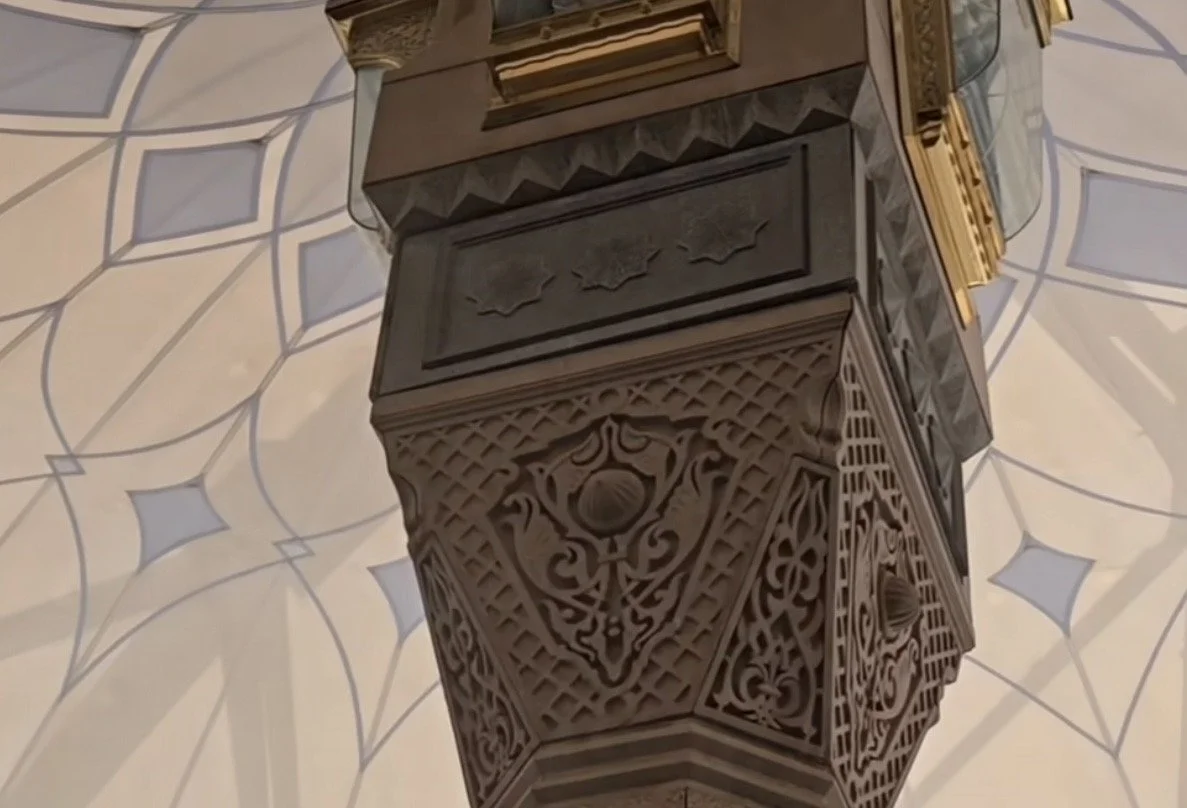
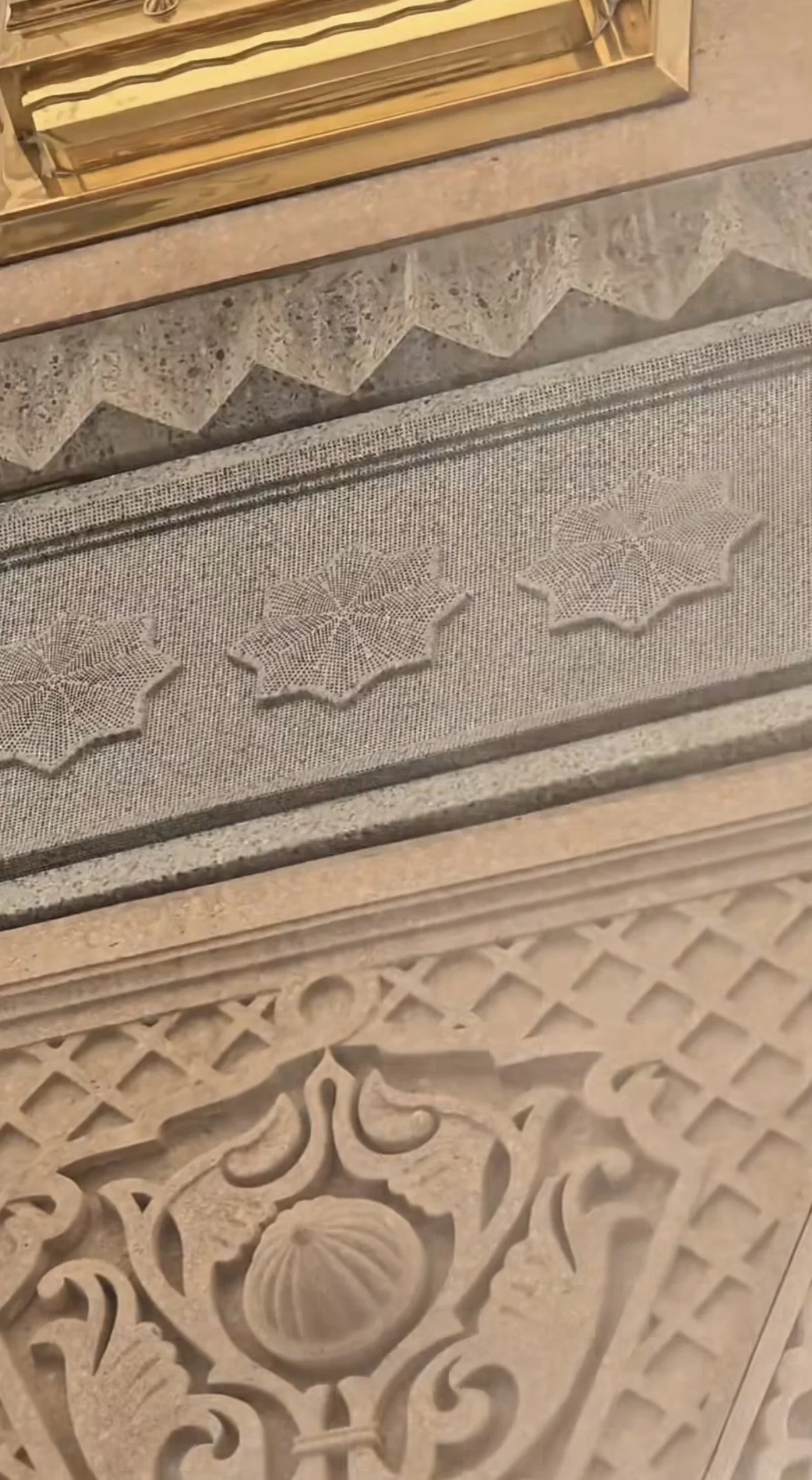
The most extraordinary element of the canopy installation is documented in another photograph from @madeenahalmunawwara — the speaker grilles for some of the canopy-area speakers are embedded directly into the decorative architectural stonework panels on the canopy undersides. The grilles are perforated fabric panels integrated within the carved stone ornamentation — completely invisible to anyone who does not know what they are looking for. Unless you are an AV professional looking specifically for speakers, you will walk beneath them without ever knowing they exist.
THE HIDDEN GRILLES: THE HIGHEST STANDARD OF INTEGRATION
The integration of speaker grilles into the carved stone panels of the canopy architecture represents something worth understanding clearly.
In most installations — even professional ones — there is a visual acknowledgment that technology is present. Speakers are visible. Grilles break the visual continuity of the architecture. At Masjid al-Nabawi, in the canopy installation, the decision was made to eliminate that acknowledgment entirely.
The acoustic engineers worked with the architectural team to embed the speaker grilles into the decorative panels themselves. The technology disappeared into the building. What remains for the worshipper is only the sound — no visible source, no reminder that they are in a technically engineered space. The Imam's voice simply arrives, clearly and evenly, from what feels like the space itself.
This is the ultimate expression of what sound reinforcement in a place of worship should be. Not impressive technology. Not visible engineering. Just the voice, and the prayer, and nothing between them.
THE MICROPHONE SYSTEM
The distributed speaker system described above is only half of the acoustic equation. The signal chain begins at the Imam's position.
Masjid al-Nabawi uses high-sensitivity condenser microphones positioned at the mihrab to capture the Imam's voice during every posture of salah — standing, ruku, and sujood. Multiple redundant microphone positions ensure that the signal is never lost regardless of the Imam's position during prayer.
The microphone signal feeds into the BSS Audio processing network, where it is conditioned, delay-aligned, and distributed to the multiple speaker zones across the complex. In a broadcast context — every prayer at al-Nabawi is transmitted live to global audiences via the Saudi Broadcasting Corporation — the accuracy of the microphone chain carries the same weight as the speaker system itself.
THE ONGOING TRANSITION
What makes the current state of the Nabawi sound system particularly interesting from a technical perspective is that it is not a finished system. It is a system in active evolution.
The Bose Panaray 402 units installed in earlier decades are still functioning and still serving parts of the congregation. Alongside them, in areas where the upgrade has been completed, Renkus-Heinz ICONYX Gen5 columns are now handling the same zones with an entirely different generation of technology. The custom UBA4-MH units under the canopies represent a bespoke engineering collaboration for a specific architectural challenge. The hidden stonework grilles represent a philosophy of acoustic invisibility that goes beyond what most AV professionals ever attempt.
The Presidency of the Two Holy Mosques is not replacing everything at once. They are upgrading methodically, zone by zone, with a standard that accepts nothing less than excellence at every stage. The congregation at al-Nabawi today is being served simultaneously by three generations of speaker technology — each one the best available at the time of its installation, each one still doing its job.
That methodical commitment to quality over time is its own kind of lesson.
